



Intel Panther Lake is officially set to redefine the boundaries of mobile computing and artificial intelligence. As a tech enthusiast, I’ve been closely tracking the semiconductor wars, and Intel’s latest move is nothing short of audacious. Officially dubbed the Intel Core Ultra Series 3, this new platform isn’t just an iterative update—it is a complete architectural overhaul designed to power the next generation of AI PCs.
For those of us obsessed with nanometers and clock speeds, the big news is the manufacturing node. This is the first PC platform built on the Intel 18A process, the company’s most advanced semiconductor node to date. Let’s dive deep into what makes this chipset a potential market leader and why the tech community is buzzing with anticipation.
Why Intel Panther Lake Changes the Game with 18A
The shift to the Intel 18A process is a massive deal. We are talking about a 2-nanometer class node. To put that in perspective, as we push the limits of physics, shrinking transistors while increasing efficiency is becoming exponentially harder. Intel claims that this new process delivers up to 15% better performance per watt and a staggering 30% improved chip density compared to Intel 3.
Fabrication is taking place at the Fab 52 facility in Arizona, signaling a strong push for domestic manufacturing capability. But it’s not just about where it’s made; it’s about *how* it’s made. The 18A process introduces two critical technologies: RibbonFET and PowerVia.
RibbonFET is Intel’s first new transistor architecture in over a decade. It utilizes a gate-all-around structure that allows for faster switching speeds in a smaller footprint. Coupled with this is the backside power delivery system known as PowerVia. By moving power delivery to the back of the wafer, Intel clears up the signal routing on the front, significantly improving signal integrity and power flow. For the end-user, this means your laptop runs cooler, faster, and longer.
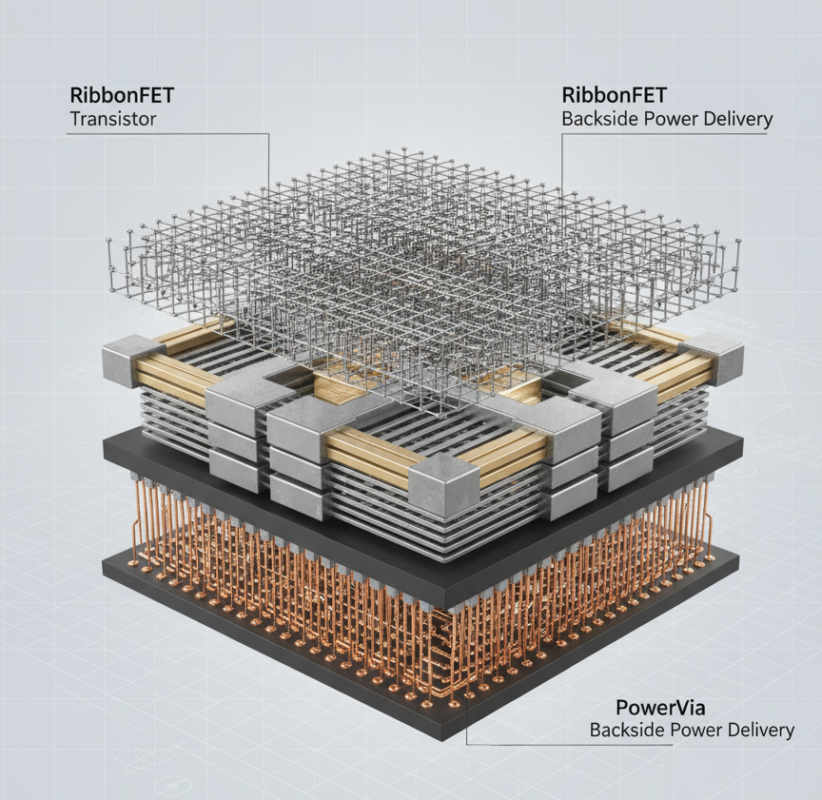
The Architecture Behind Intel Panther Lake
When we look under the hood, the Intel Panther Lake architecture reveals a sophisticated multi-chiplet design. This approach allows Intel to mix and match different tiles (compute, graphics, SoC) optimized for specific nodes, connected via Foveros technology.
Foveros is Intel’s advanced 3D packaging technology. It allows for vertical stacking of compute tiles, which is essential for maintaining a small footprint in thin-and-light laptops while maximizing performance. Intel has stated that the 18A node will be the foundation for at least three upcoming generations of client and server products, making Panther Lake the pioneer of a new era.
Performance Metrics: A Quantum Leap?
We need to talk about raw numbers. The specs released for the Core Ultra Series 3 are impressive. Intel is promising up to 16 new cores, comprising both Performance cores (P-cores) and Efficient cores (E-cores). The result? A claimed 50% faster CPU performance compared to its predecessor.
But the real star of the show might be the graphics and AI capabilities. The SoC comes equipped with the new Intel Arc GPU, featuring up to 12 Xe cores. Intel claims this will deliver more than 50% faster graphics performance. For creators and gamers, this means smoother editing timelines and higher frame rates on integrated graphics.
Furthermore, in the age of local LLMs and generative AI, the NPU (Neural Processing Unit) is critical. Intel Panther Lake is claimed to offer up to 180 trillion operations per second (TOPS) for AI workflows. This is a massive figure that puts it squarely in competition with the best mobile silicon on the market.

Overcoming the Rumors
It hasn’t been smooth sailing entirely. Last year, the rumor mill was churning with reports that Intel was struggling to optimize the 18A process, with yields allegedly being too low. However, Intel has firmly shut down those concerns. The company confirmed that plans are on track and that the Panther Lake chips will indeed be shipped later this year.
This confirmation is vital for investor confidence and for OEMs waiting to integrate these chips into their holiday lineups. The ability to execute on the 18A roadmap is perhaps the most critical test for Intel’s foundry services strategy.
Conclusion: The Future is Panther Lake
As we look toward the release later this year, Intel Panther Lake stands as a testament to Intel’s resilience and engineering prowess. By combining the 18A process, RibbonFET, PowerVia, and Foveros 3D packaging, they are not just catching up; they are aiming to leapfrog the competition.
For tech enthusiasts, the arrival of the Core Ultra Series 3 means our laptops are about to get a whole lot smarter and faster. Whether you are training AI models locally or just want a snappy experience with great battery life, Panther Lake is the platform to watch.